
How to Prevent Mosquitoes in Your Pond
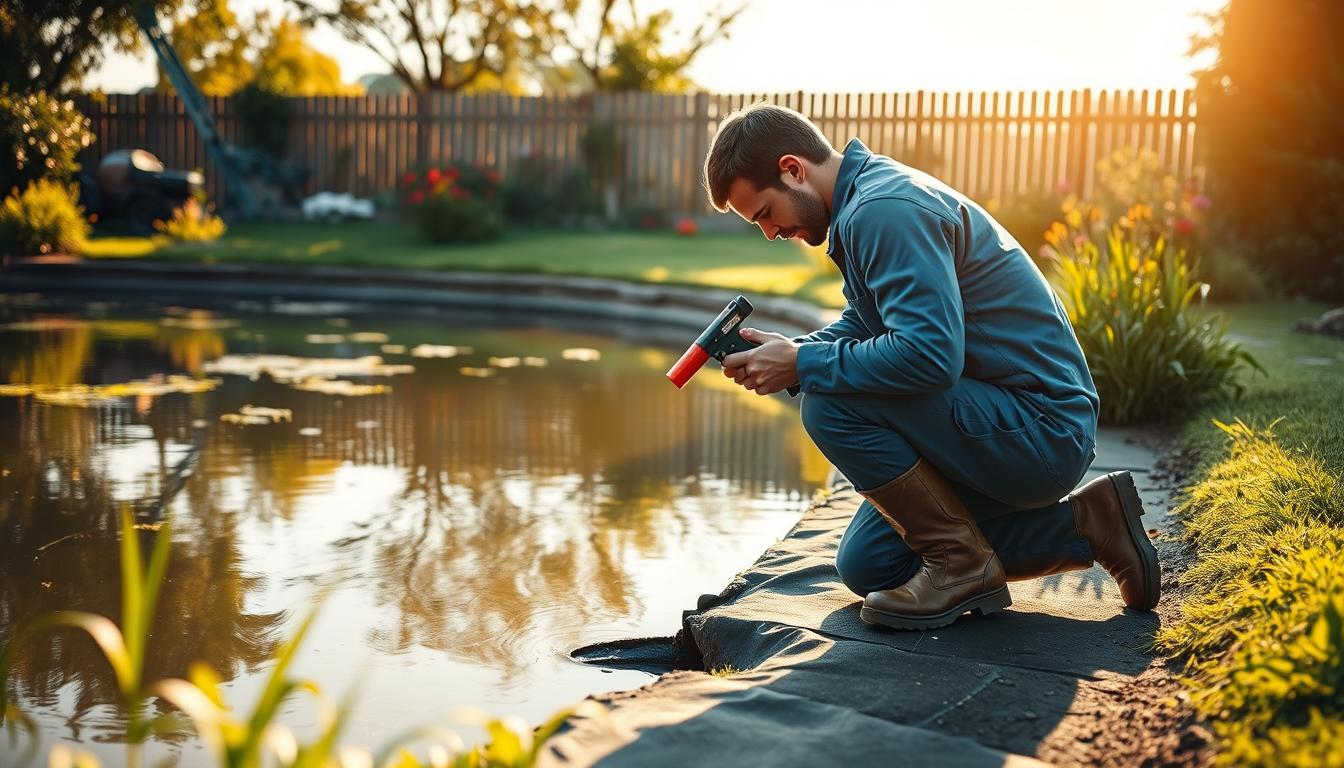
This practical guide helps U.S. homeowners tell normal water loss from a true problem and then fix it without needless expense.
Start by measuring daily losses: breezy summer days can cause about a quarter-inch per day from evaporation, adding up to nearly four inches in two weeks. Well-built liners still may seep about an inch per month, while tree roots from willows or maples can remove several inches monthly.
If reductions exceed roughly 12 inches in the driest month, you likely face a real leak rather than routine loss. A methodical approach saves time and money by avoiding unnecessary tear-outs of a water feature.
Goals: first pinpoint where the water is escaping, then choose the right fix — from simple liner patches and soil seals to bentonite or full liners. Check valves and turn off auto-fill during testing so the system does not mask a problem.
We’ll highlight common failure points, safety steps, and short-term fish care, plus a 24-48 hour monitoring window after any repairs to confirm success.
Key Takeaways
- Measure losses to distinguish normal evaporation from a real leak.
- Turn off auto-fill and inspect edges, fittings, and outlet pipes first.
- Choose fixes based on the cause: patching, soil seals, bentonite, or full liners.
- Expect tree roots and aging plumbing to cause faster water loss.
- Plan for permits, costs, and fish care; monitor 24–48 hours after work.
Understand Pond Water Loss: Evaporation vs. Actual Leaks
Distinguishing routine evaporation from a true breach starts with simple measurements over time.
Normal U.S. summer evaporation often reaches about 0.25 inches per day on warm, breezy, low-humidity days. That can add up to nearly four inches over 14 dry days. Well-built liners may still show about one inch of seepage each month.
Tree uptake and drought impacts
Trees like willows and maples may draw several inches monthly directly from the surface, making a feature seem like it is losing water faster. Droughts can also dry exposed banks; when the feature refills, new cracks may form.
How to benchmark
Turn off auto-fill, mark the starting level, and record daily changes for two weeks without rain. Use the log to spot steady decline versus step-changes that point to a specific elevation problem.
When to test with dye
“A small, food-grade dye test can reveal movement from a suspect spot; use only minimal amounts and watch for flow.”
- Compare daily drops to expected evaporation and seepage.
- If losses exceed about 12 inches in the driest month, investigate further.
- Consider wind exposure and a small watershed, which magnify normal declines.
Quick Checks Before You Start Full Pond Leak Repair
Begin by isolating the system so you can watch where the water settles and what that tells you.
Turn off auto-fill devices and mark the water level
Switch off any automatic fill so you do not mask an active loss. Mark the starting water level on a fixed surface and note the time. Record changes hourly or daily to build a reliable baseline.
Safety and livestock/swimmer considerations around low water
If the water drops quickly, move fish to an aerated holding tank. Slippery banks and exposed sediments can be dangerous for children, pets, or livestock in a backyard setting. Keep caution tape up if needed.
“Simple observations often reveal whether the basin holds water or if the problem is upstream.”
- Keep pumps off at first to see if the basin itself holds water.
- Inspect visible gear later—skimmer lids, return fittings, and hose clamps—for drips.
- Document each step so you change only one variable at a time during the diagnostic process.
Systematic Leak Detection: From Bottom-Up to Waterfall and Stream
Start low and work up. Pause circulation and let the water settle until the level holds steady. That steady elevation usually marks the bottom of the problem area.
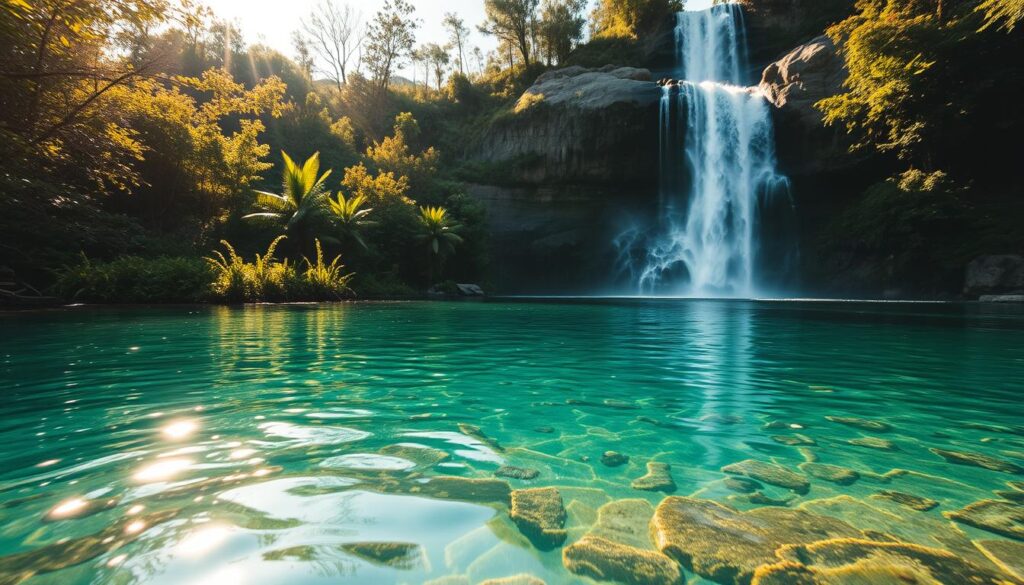
Let the water level settle to find the leak elevation
Turn off fills and pumps and watch the surface for several hours or a day. When the level stops dropping, focus inspection at that contour around the basin and banks.
Dye test method: when and how to use food-grade dye
Use a tiny amount of food-grade dye near suspected edges. If the colored water moves into a seam, crack, or subsurface pipe, you have a clear path to follow.
Inspect dam/banks for wet spots, cattails, and seepage trails
Walk the outside toe of dams and banks. Look for persistent wet spots or plants like cattails and rushes that signal seepage lines.
Skimmer, return line, UV, and fittings: tracing the plumbing under flow
- Bring the system online and follow plumbing from skimmer to waterfall, checking joints, hose clamps, and UV housings for sprays.
- Check older outlet or drain pipes for rust-through below the surface.
- Remove a few rocks to expose liner edges and the stream connection, then replace them after inspection.
“Document each finding and change one item at a time to isolate the source efficiently.”
Common Culprits in Backyard Water Features
Many homeowners first discover problems where a stream or cascade drops over an under-supported liner. These low edges let water flow out of the system and into surrounding soil after only modest settling.
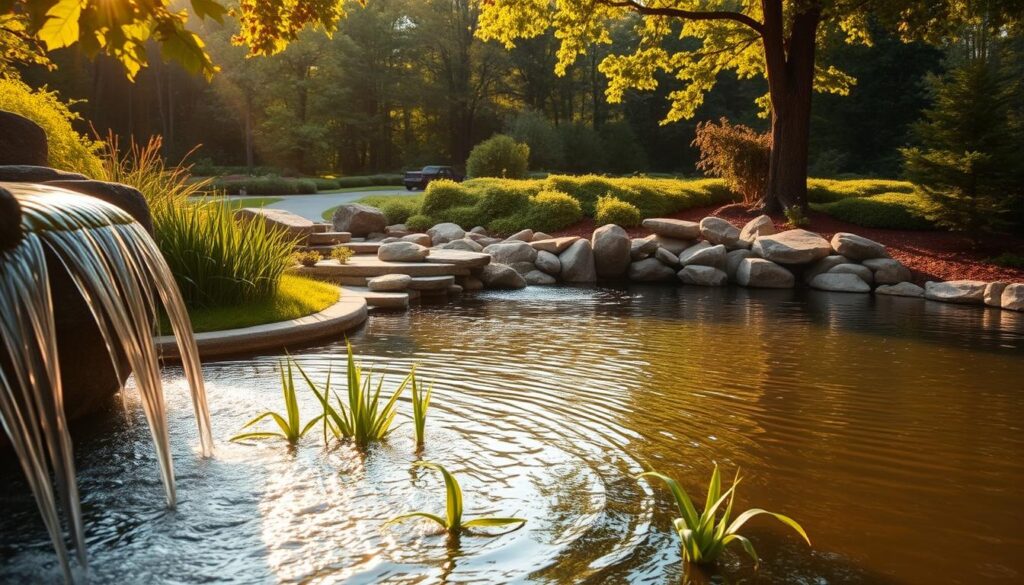
Low liner edges in streams and waterfalls
Why it matters: A liner that sits too low behind rocks or at a waterfall allows continuous bypass. Small shifts in soil create chronic loss rather than a sudden hole.
Loose joints, hose clamps, and skimmer seals
Thermal cycles and vibration loosen fittings. Loose joints and worn hose clamps often show visible drips when pumps run.
Skimmer gaskets can harden and fail. Cleaning and resealing these seals usually restores watertight connections.
Outlet or drain pipe failures in older installations
Hidden corrosion under the surface causes unseen leaks in aging systems. Look for wet ground, cattails, or persistent soggy spots at the bank toe.
“Trace water paths across rocks and spillways — subtle bypasses are common and can be mistaken for a bottom hole.”
- Check multiple low points along the stream instead of assuming one fault.
- Preventive maintenance of clamps and seals reduces recurring water loss in busy backyard settings.
- Re-leveling and shoring liner edges with soil or rocks helps stop future settling-induced leaks.
Repair Methods for Liners and Water Features
A practical first step is to lift and secure low liner edges so water follows the intended path. Repositioning and shoring with compacted soil, mulch, gravel, or placed rocks stabilizes sagging margins and prevents future settling.
Repositioning and shoring
Gently lift the liner, tuck it to the correct elevation, and backfill with layered soil or gravel. Finish with decorative rocks to hide the edge and reduce movement over time.
Patch kits and the process
Most patch kits include primer, a self-adhesive patch, and a roller. To use: drain pond locally to the damaged spot, clean and dry the area, apply primer, cut a rounded patch, roll it firmly on, and allow set time before refill.
Joining tape, waterfall foam, and sealants
Double-sided joining tape adds material where margins are short and reseals skimmer box flanges after priming. Waterfall foam blocks bypass behind rocks and forces flow over the liner.
A bead of compatible sealant helps fittings and skimmer flanges, but wide failures usually call for tape, new gaskets, or a full liner replacement when cumulative fixes cost more than replacement.
“Always test the repaired section under flow before rebuilding rock work so you confirm success.”
- Match materials (EPDM, PVC) to primers and tapes for a reliable bond.
- All adhesive methods need clean, dry surfaces and proper curing time.
- Test under flow and document material types and actions taken for future maintenance.
Pond Bottom and Soil-Based Solutions
Good bottom sealing begins with knowing the soil mix and working in the right moisture window. For any soil-based solution, drain pond sections so the base is visible and stable before you begin.
Compaction: moisture window and layer thickness
Scarify the top 12–16 inches and compact at optimum moisture for best density. Aim for a final compacted layer of at least 6 inches in shallow zones and about 12 inches where depth reaches roughly 10 feet.
Clay blankets: how to install
Use soil with at least 20% clay. Spread 6–12 inch lifts, then compact. In deep areas plan for about 12 inches of compacted clay. Protect exposed clay from drying or freezing with mulch or straw if immediate refill isn’t possible.
Bentonite and chemical additives
Bentonite performs best on coarse, low-clay subgrades. Apply roughly 1 lb/sq ft, mix to 3–4 inches, and refill quickly to prevent shrinkage cracking. Broadcasting onto standing water usually has limited success and suits only tiny, shallow problems.
For high-clay soils, sodium polyphosphate (0.05–0.10 lb/sq ft) can break aggregates. Mix it into the top 8–10 inches and compact after blending.
- Tip: Always expose and clean the base before work.
- Test soils through NRCS or a local lab to confirm particle sizes before committing to a method.
Plastic Liners, Permits, Costs, and Planning Your Repairs
Choosing the right liner and a clear plan makes long-term fixes far cheaper than repeated spot work. Start by matching material thickness to your substrate: use ~8 mil in fine soils and up to ~30 mil for coarse, abrasive grounds.
Material selection and substrate prep
Remove rocks and sharp debris and smooth the subgrade. Add a protective cushion and plan for at least 9 inches of soil cover where people or livestock may contact the surface.
Permits and agency coordination
Contact state DEP or local dam safety programs early. If the feature had a Bureau of Dam Safety permit, additional approvals may be needed before major work.
Cost ranges and planning logistics
- Clay: labor plus material; clay costs vary by region.
- Bentonite: $50–$100/ton (plus hauling).
- Plastic liner: roughly $25/sq ft and up, excluding equipment and labor.
“Compare cumulative spot fixes to full liner replacement to find the most economical solution.”
Make-up water and hydrology cautions
Using a home well or spring for make-up is fine for small loss, but pumping over 10,000 gpd can trigger registration and stress wells during drought. Consult a hydrologist before sustained pumping and document all materials and thicknesses for future maintenance and reviews.
Pond Leak Repair: Step-by-Step Workflow and Pro Tips
Start work at the known waterline and move outward so you change only one variable at a time. A clear sequence saves time and reduces guesswork when addressing loss.
Drain, expose, clean, and dry: preparing the repair area
Safely lower the level to expose the damaged bottom or seam. Remove debris and biofilm so adhesives bond to clean material.
Dry the surface thoroughly before priming. Follow the manufacturer directions for primer and set time.
Fish care during repairs: holding tanks and aeration
If water falls too low, move fish to a clean holding tank sized for your stock. Add an aerator and a thermometer to keep oxygen and temperature near original pond conditions.
Change only what is needed; keep handling brief and avoid crowding.
Rebuild, refill, and monitor: validating the fix over 24-48 hours
Apply the patch: prime, cut a rounded patch, roll it firmly, and wait the recommended cure time before refilling. For plumbing work, depressurize lines, replace clamps or gaskets, and use compatible sealants.
“Refill slowly while watching the marked level to confirm no unexplained loss.”
- Rebuild rock work and shoring stepwise so water flows over, not behind, liners.
- Monitor 24–48 hours with the system off; then run pumps and recheck skimmer seals, fittings, and waterfall edges.
- Use a small dye test only if a suspicious spot remains, and document all materials and observations.
Conclusion
Always confirm rates of loss with a simple level log before making changes.
Distinguish normal evaporation from true failure by recording daily drops; evaporation often equals about 0.25 inch per warm day and rarely exceeds roughly 12 inches in the driest month when combined with tree uptake.
Work bottom-up and change one variable at a time to locate the exact failure point. Inspect low liner edges, fittings, skimmer seals, and outlet pipes; each needs a targeted fix from patching and foam to soil compaction, clay, bentonite, or a new pond liner.
Plan for safety, fish welfare, and needed permits. After any work, monitor for 24–48 hours with the system static, then again under flow to confirm success.
Keep an annual check of edges, fittings, and flows after freeze-thaw cycles. If measured losses still exceed expected evaporation, repeat diagnostics and consult local experts (NRCS, DEP, or a hydrologist) for faster resolution.
Use this method as a reliable framework to protect your water feature and avoid unnecessary expense.
You Might Also Like...